Learn exactly how to start affiliate marketing for free — even if you have no experience, no website, and no money to invest. Follow this simple step-by-step guide to build an online business from scratch.
Introduction
When I first started learning about affiliate marketing, I made the same mistake that most beginners make.
I tried to learn everything at once.
One article told me I needed a website.
Another said YouTube was the secret.
Someone else insisted I had to spend hundreds of dollars on ads.
Everywhere I looked, people seemed to have a different opinion.
Instead of feeling excited, I felt overwhelmed.
Looking back, I realize the problem wasn’t affiliate marketing.
The problem was that nobody explained it in a simple, step-by-step way.
That’s exactly why I created this guide.
If you’re wondering how to start affiliate marketing for free, this guide will walk you through every step.
If I had to start over today with zero experience and zero dollars, this is the process I would follow.
No complicated strategies.
No expensive software.
No unrealistic promises.
Just a simple system that anyone can learn.
By the end of this guide, you’ll know:
- What affiliate marketing really is
- How affiliate links work
- How to choose a profitable niche
- Where to find free affiliate programs
- How to create content people actually want to read
- How to get free traffic from Google, Pinterest, and social media
- How to build trust with your audience
- The biggest mistakes beginners make
- A simple 30-day action plan you can start today
Whether your goal is to earn an extra $100 a month or build a full-time online business, these are the same basic steps successful affiliate marketers use every day.
Let’s get started.
What Is Affiliate Marketing?
Quick Answer
Affiliate marketing is a business model where you earn a commission for recommending another company’s products or services using a unique affiliate link.
When someone clicks your link and completes a qualifying action—usually buying something—you receive a commission.
The customer doesn’t pay anything extra.
Instead, the company shares part of its marketing budget with you because you introduced them to a new customer.
That’s really all affiliate marketing is.
Simple.
How Affiliate Marketing Works
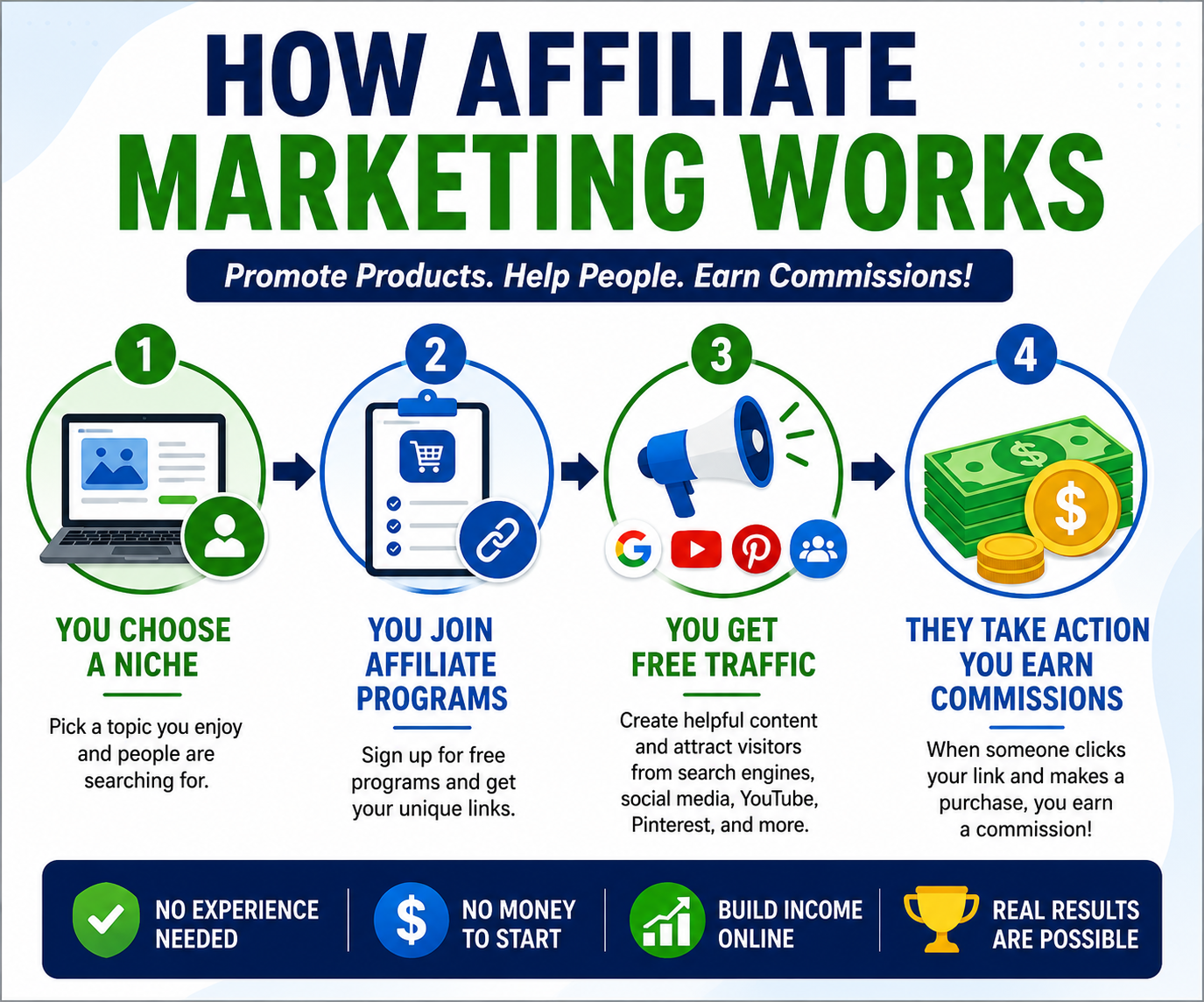
Affiliate marketing follows the same four steps over and over.
- Join an affiliate program.
- Receive your unique affiliate link.
- Create helpful content that includes your recommendation.
- Earn a commission when someone makes a qualifying purchase.
That’s the entire business model.
The difficult part isn’t understanding how it works.
The difficult part is consistently creating content that genuinely helps people.
Once people trust your recommendations, sales become much easier.
A Simple Example
Imagine you buy a gardening book that teaches you how to grow better tomatoes.
You follow the advice.
A few months later, your garden is producing more tomatoes than ever before.
A neighbor notices and asks what you did.
You recommend the same book because it actually helped you.
Now imagine the publisher gives you a special referral link.
Every time someone buys the book through your link, you earn a commission.
That’s affiliate marketing.
You helped someone solve a problem.
The company rewarded you for bringing them a customer.
Why So Many Beginners Choose Affiliate Marketing
There are dozens of ways to make money online.
You can:
- Sell physical products
- Offer freelance services
- Build software
- Create an online course
- Start a dropshipping business
All of those can work.
But affiliate marketing has one huge advantage.
You can start with very little risk.
Let’s look at why so many beginners choose it.
You Don’t Need to Create Your Own Product
Creating a product takes time.
You have to plan it.
Build it.
Test it.
Improve it.
Then market it.
With affiliate marketing, someone else has already done all of that.
Your job is simply to connect the right people with the right solution.
You Don’t Handle Customer Support
Imagine selling your own product.
Customers might email you every day asking questions.
Some will request refunds.
Others will need technical support.
If you sell physical products, you’ll also deal with shipping problems and returns.
With affiliate marketing, the company usually handles all of that for you.
That means you can spend your time creating helpful content instead of answering support emails.
You Can Work From Anywhere
One of my favorite things about affiliate marketing is the flexibility.
As long as you have an internet connection, you can work almost anywhere.
Some people build their business after work.
Others spend an hour each morning creating content before their day begins.
You don’t need an office.
You don’t need employees.
You simply need a willingness to keep learning and helping people.
You Can Start Without Spending Money
One question I hear all the time is:
“Can I really start affiliate marketing for free?”
Yes.
There are free:
- Affiliate programs
- Blogging platforms
- Website builders
- Email marketing tools
- Keyword research tools
- Graphic design tools
- Social media platforms
As your business grows, you may decide to invest in premium tools because they save time.
However, you don’t need them to get started.
The most valuable thing you can invest in at the beginning isn’t money.
It’s consistency.
Publishing one helpful article every week will usually move your business forward much faster than buying another shiny tool.
Is Affiliate Marketing Worth It in 2026?
Short Answer
Yes—but only if you’re willing to be patient.
Affiliate marketing is not a get-rich-quick business.
Anyone promising overnight success is setting unrealistic expectations.
I like to compare affiliate marketing to planting a tree.
At first, it doesn’t look like much is happening.
You’re writing articles.
Learning SEO.
Creating Pinterest pins.
Building an email list.
Helping people one reader at a time.
Then one day something changes.
One article starts ranking in Google.
Another gets shared on social media.
Someone joins your email list.
Then your first commission arrives.
After that, the second one usually feels much easier because you know the system works.
In fact, the people who succeed aren’t always the smartest.
They’re usually the ones who kept going while everyone else gave up.
How to Start Affiliate Marketing for Free Step 1: Choose Your Niche
Everything starts here.
One of the biggest mistakes I see beginners make is trying to build a website about everything.
- Fitness
- Travel
- Cooking
- Technology
- Pets
- Personal finance
- Affiliate marketing
It might seem like you’re giving yourself more opportunities.
In reality, you’re making it harder for readers—and search engines—to understand what your website is about.
Instead, choose one topic and become known for helping people in that area.
Google also prefers websites with a clear focus because they’re easier to understand and more likely to demonstrate expertise over time.
How to Choose a Niche to Start Affiliate Marketing for Free
A niche is simply the main topic your content focuses on.
Some examples include:
- Affiliate marketing
- Email marketing
- Personal finance
- Home gardening
- Photography
- Cooking
- Camping
- DIY projects
- Online business
- Web traffic
Every article you publish should relate to that main topic.
Doing this helps readers know what to expect and helps search engines understand your website.
It also makes it much easier to build authority over time.
How to Pick the Right Niche
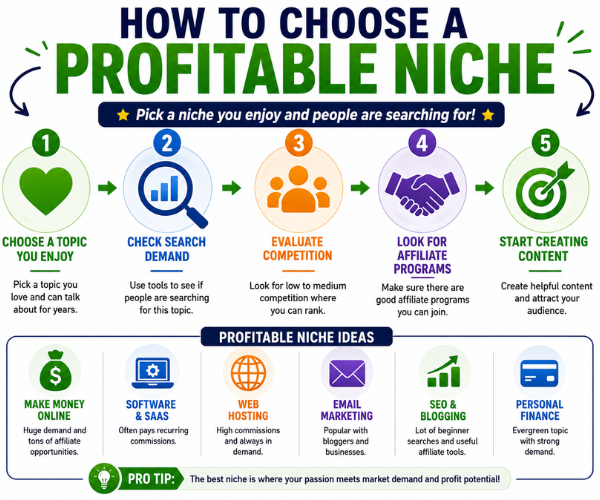
Choosing a niche is one of the most important decisions you’ll make.
The good news?
You don’t have to choose the “perfect” niche.
You just need one that’s a good fit for you.
Ask Yourself These Five Questions
Before choosing a niche, ask yourself:
- ✅ Do I enjoy learning about this topic?
- ✅ Can I create content about it for the next few years?
- ✅ Does it solve real problems?
- ✅ Are people already spending money in this niche?
- ✅ Are there affiliate programs available?
If you answered “yes” to most of those questions, you’re probably looking at a good niche.
Remember, you don’t need to be the world’s leading expert.
When I started learning about affiliate marketing, I certainly wasn’t.
I simply learned one step at a time and shared what I discovered along the way.
That’s something every beginner can do.
In fact, documenting your journey often makes your content more relatable because you’re answering the same questions your readers have.
Beginner Tip
Don’t spend weeks trying to choose the perfect niche.
Perfection doesn’t exist.
Pick one that’s a good fit and start creating content.
You can always narrow your focus later as you learn more about your audience.
Taking action today is almost always better than waiting for the “perfect” plan.
How to Start Affiliate Marketing for Free Step 2: Understand Affiliate Links
Before you recommend products, it’s helpful to understand what an affiliate link actually does.
An affiliate link looks almost identical to a normal website link.
The difference is that it contains a unique tracking code.
When someone clicks your link, the company knows you referred that visitor.
If they complete a qualifying action—usually making a purchase—you earn a commission.
You don’t need to understand all the technical details.
The affiliate program handles the tracking automatically.
Your job is much simpler.
Create helpful content.
Build trust.
Recommend products that genuinely solve problems.
When people find your content useful, they’ll naturally click your recommendations.
Do Affiliate Links Cost Customers More?
No. Affiliate links don’t increase the price customers pay.
This is one of the biggest myths beginners believe.
Affiliate commissions are paid by the company—not by the customer.
The customer pays exactly the same price whether they use your affiliate link or visit the company’s website directly.
That’s why affiliate marketing is considered a win for everyone involved.
The customer finds a solution.
The company gains a new customer.
You earn a commission for making the introduction.
How to Start Affiliate Marketing for Free Step 3: Find the Right Affiliate Programs
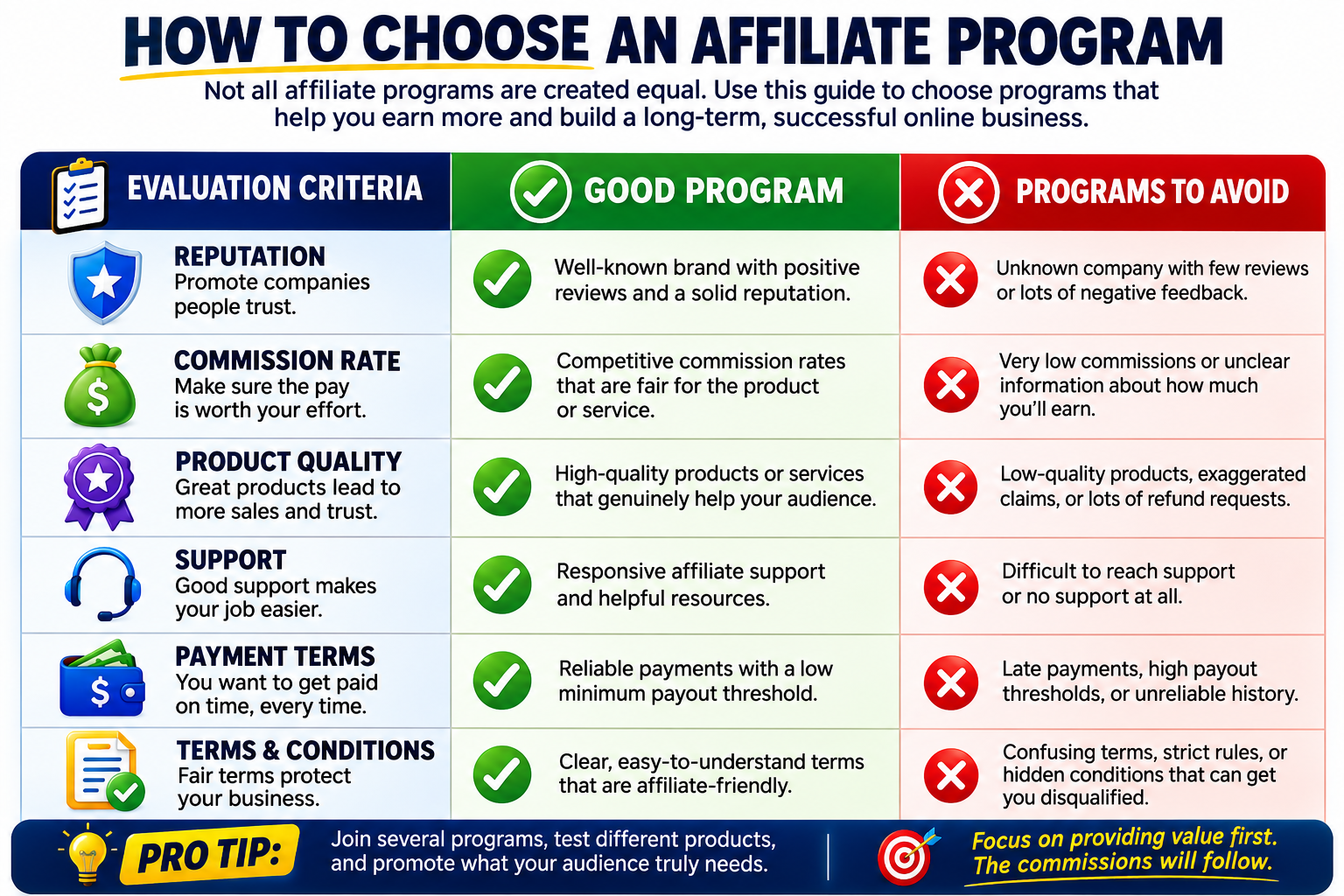
One mistake beginners often make is trying to join dozens of affiliate programs at once.
You don’t need fifty affiliate programs.
Instead, you only need a few good ones.
Quality almost always beats quantity.
Where to Find Affiliate Programs to Start Affiliate Marketing for Free
Affiliate programs are everywhere.
One of the easiest ways to find them is simply by searching Google.
Try searches like:
- Affiliate marketing software affiliate program
- Email marketing affiliate program
- Website builder affiliate program
- Fitness affiliate program
- Gardening affiliate program
Or search:
Company Name + Affiliate Program
You’ll be surprised how many companies offer one.
Popular examples include Amazon Associates and ClickBank, which give beginners access to thousands of products across many different industries.
Look for Products That Solve Problems
People don’t buy products.
They buy solutions.
Think about it.
Someone isn’t looking for an email marketing platform.
They’re looking for a way to build an email list.
Someone isn’t searching for a website builder.
They’re trying to create a website that attracts visitors.
Someone isn’t buying a gardening tool.
They’re trying to grow healthier plants.
The better a product solves a real problem, the easier it becomes to recommend naturally.
Choose Products You’d Recommend Anyway
Here’s a simple question I ask myself before promoting anything.
“Would I recommend this if I weren’t earning a commission?”
If the answer is yes, it’s probably worth recommending.
If the answer is no, I move on.
One commission isn’t worth damaging your reputation.
Trust takes a long time to build.
It only takes one bad recommendation to lose it.
Don’t Promote Too Many Products
This is another lesson many affiliates learn the hard way.
When every article recommends ten different products, readers don’t know which one to choose.
Instead, focus on recommending a handful of tools you genuinely believe in.
You’ll build much more credibility over time.
Step 4: Understand Different Types of Affiliate Commissions
Not every affiliate program pays in the same way.
Understanding the different commission types will help you choose programs that match your goals.
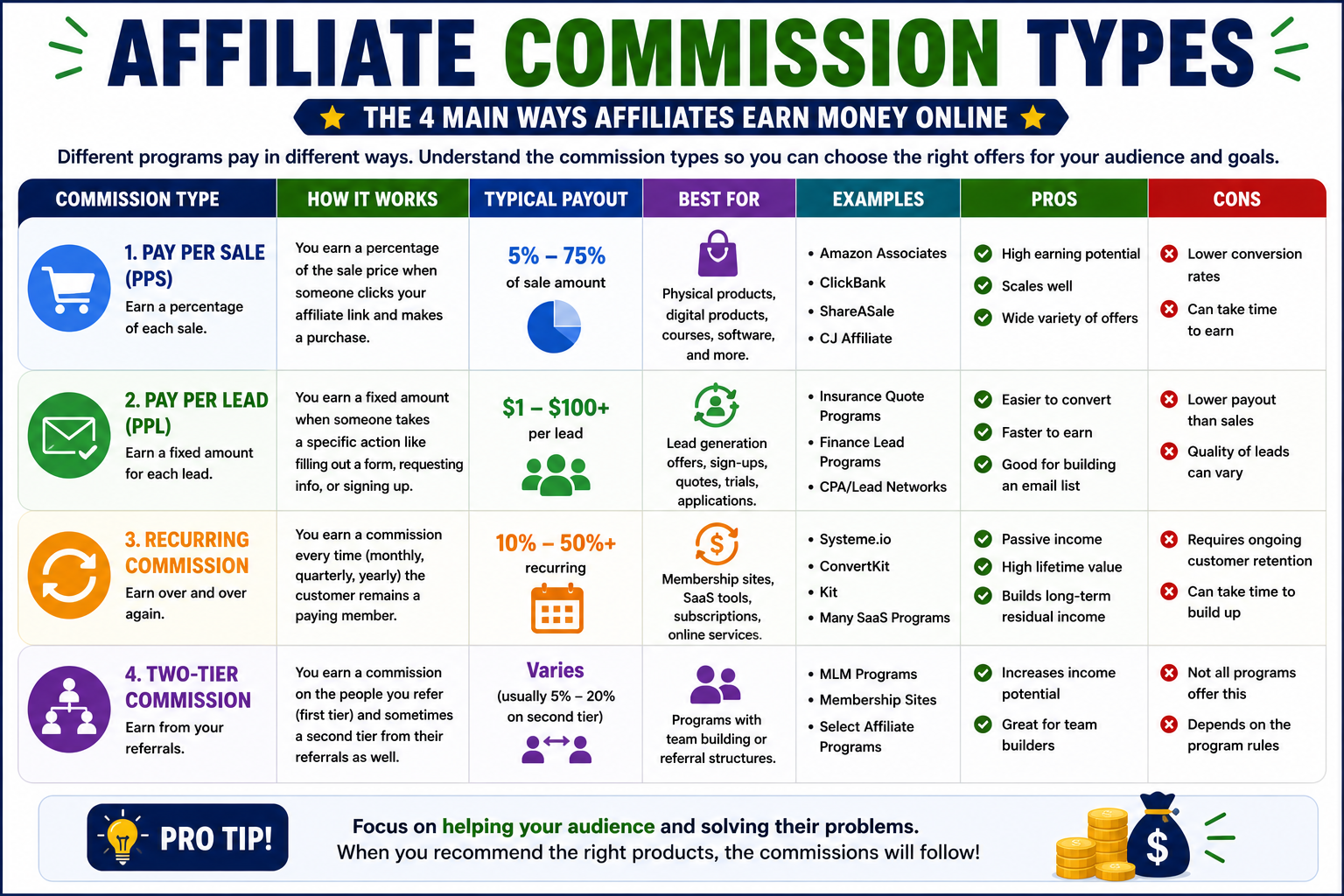
Most affiliate programs fall into one of these categories:
- Pay Per Sale (PPS) – You earn a commission when someone purchases a product through your link.
- Pay Per Lead (PPL) – You earn money when someone completes a specific action, such as filling out a form or signing up for a free trial.
- Recurring Commissions – You continue earning as long as the customer keeps paying for a subscription.
- Two-Tier Commissions – Some programs also reward you when affiliates you refer earn commissions.
There’s no single “best” commission type.
Many successful affiliate marketers earn money from a combination of one-time commissions and recurring income.
As your business grows, you’ll naturally discover which types fit your niche best.
What Is an Affiliate Cookie?
This sounds technical, but it’s actually very simple.
An affiliate cookie is a small piece of information that tells a company you referred a visitor.
Here’s an example.
Someone clicks your affiliate link today.
They don’t buy anything.
Three days later they come back and make a purchase.
If the cookie is still active, you’ll usually receive credit for the sale.
Different affiliate programs use different cookie lengths.
Some only last 24 hours.
Others last 30 days.
Some even last a full year.
Longer cookie durations can increase your chances of earning commissions, especially when people take time to make buying decisions.
Whenever possible, take a minute to check the cookie length before joining an affiliate program.
Step 5: Avoid Affiliate Marketing Scams
Most affiliate programs are legitimate.
Unfortunately, not all of them are.
Before joining any program, spend a few minutes doing some research.
It could save you a lot of frustration later.
You may also want to check out a company’s reputation on the Better Business Bureau (BBB) before joining. It’s a quick way to see customer complaints, ratings, and how the company responds to issues.
Warning Signs to Watch For
Be careful if a program:
- Promises guaranteed income.
- Claims you’ll get rich overnight.
- Doesn’t clearly explain how commissions work.
- Has lots of negative reviews.
- Doesn’t provide contact information.
- Uses high-pressure sales tactics.
If something sounds too good to be true, it usually is.
Read Reviews Before Joining
Whenever I’m considering a new affiliate program, I always ask a few simple questions.
- Does the company have a good reputation?
- Do affiliates actually get paid?
- Are customers happy?
- Does the company respond to support requests?
No company is perfect.
However, consistent positive reviews are usually a good sign.
How to Start Affiliate Marketing for Free Step 6: Create Your Free Online Platform
Now it’s time to create a place where people can find your content.
Many beginners think they need an expensive website before they can start.
The good news is that you don’t need an expensive website to get started.
There are several free platforms where you can begin building an audience while you learn.
For example:
- A free blogging platform
- Medium
- YouTube
- Quora
The platform you choose matters much less than consistently creating helpful content.
If you’d like to create your own website, check out my guide on How to Build a Website for Free.
Why I Still Recommend Having Your Own Website
Free platforms are a fantastic place to begin.
But your long-term goal should be to build a website that you own.
I like to think of it this way.
Social media is rented land.
By comparison, your website is land you own.
Plus, social media algorithms can change overnight.
Accounts can be suspended.
Reach can disappear.
But a website gives you complete control over your content.
Every article you publish becomes another opportunity for someone to discover your business through Google.
That’s one reason blogging remains one of my favorite long-term traffic strategies.
You create an article once, and it has the potential to bring visitors for months—or even years.
Step 7: Learn to Build Trust
Here’s something I wish someone had told me when I first started.
Affiliate marketing isn’t really about affiliate links.
It’s about trust.
People don’t buy because you posted a link.
They buy because they believe your recommendation will help them.
Every helpful article you write builds a little more trust.
Every honest review builds a little more credibility.
Every useful tip gives readers another reason to come back.
Over time, that trust becomes one of your biggest assets.
The good news is you don’t need thousands of followers to earn people’s trust.
Instead, you simply need to be honest, helpful, and consistent.
Don’t Recommend Everything
One mistake many beginners make is promoting every product they come across.
I understand why.
When you’re starting out, every commission looks exciting.
But recommending too many products often has the opposite effect.
Readers start wondering whether you’re trying to help them—or simply make a sale.
Instead, recommend products that genuinely fit your audience.
If something doesn’t provide value, don’t promote it.
After all, one commission isn’t worth damaging your reputation.
Tell the Truth About Products
No product is perfect.
It’s okay to say that.
In fact, readers usually trust balanced reviews much more than overly enthusiastic ones.
For example:
“This tool is excellent for beginners, but larger businesses may eventually need something with more advanced features.”
Statements like that show you’re trying to help people make good decisions instead of simply earning commissions.
Always Disclose Affiliate Links
If you’re using affiliate links, tell your readers.
A simple disclosure is both honest and, in many places, legally required.
If you’re unsure what to include, the FTC Endorsement Guides explain the disclosure requirements for affiliate marketers in plain language.
Something as simple as this works well:
This article contains affiliate links. If you purchase through these links, I may earn a commission at no additional cost to you. I only recommend products I believe can genuinely help my readers.
Most people appreciate the honesty.
Some will even use your links because they want to support your work.
Start Building an Email List Early
If there’s one thing I would encourage every beginner to do from day one, it’s this:
Start building an email list.
I explain the process step by step in my guide How to Build an Email List for Free.
Many affiliate marketers wait until they already have traffic.
I think that’s backwards.
Imagine someone finds one of your articles today.
They enjoy it.
Then they leave.
Without an email list, there’s a good chance you’ll never see them again.
On the other hand, if they join your list, you can continue helping them with new articles, free resources, and useful recommendations.
Unlike social media, your email list belongs to you.
No algorithm can suddenly decide your subscribers won’t see your emails.
That’s one reason many experienced affiliate marketers consider their email list their most valuable business asset.
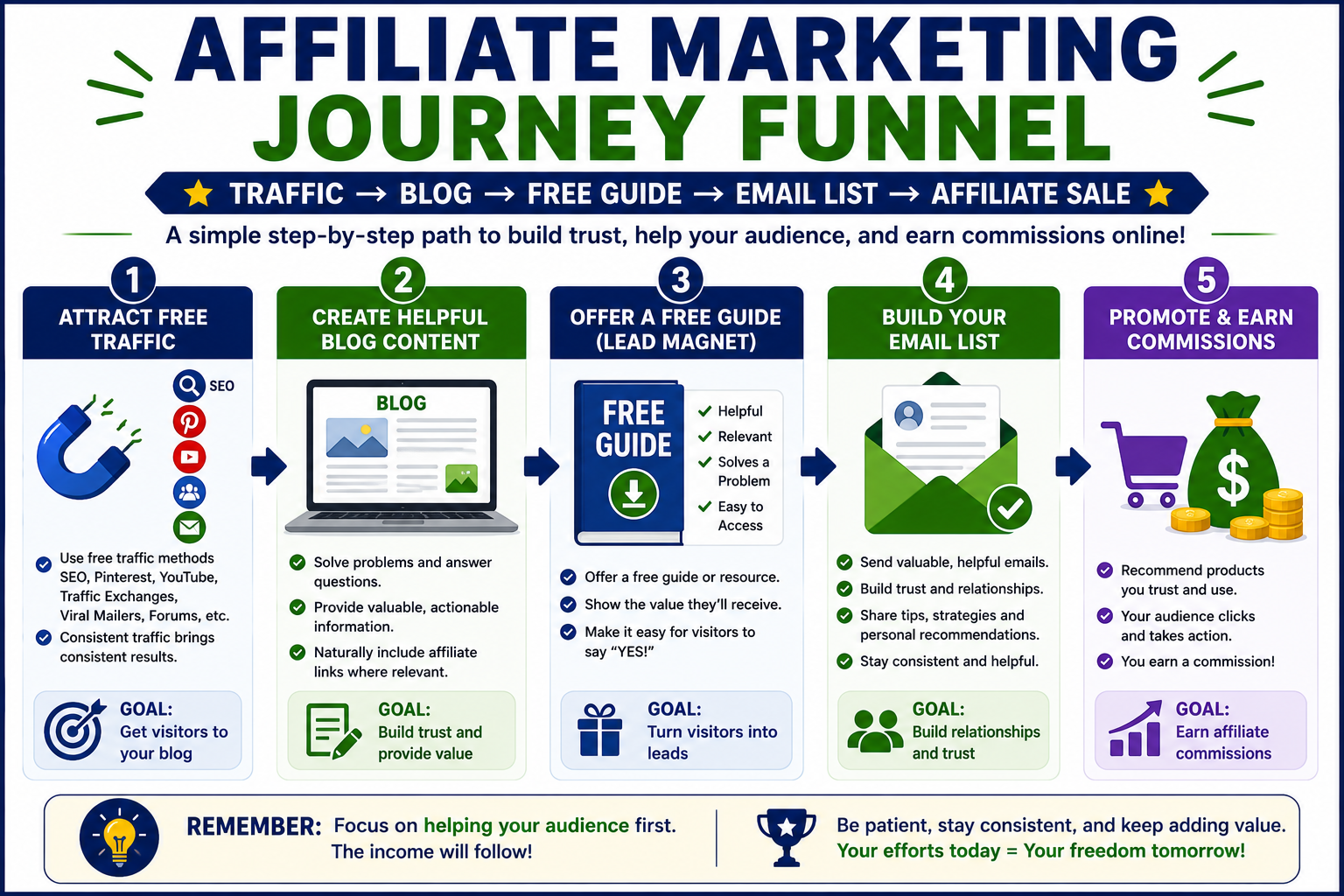
Notice something important about the diagram.
The commission comes at the end.
Most beginners focus on making a sale.
Successful affiliate marketers focus on helping people first.
When you consistently provide value, sales become a natural result of the trust you’ve built.
Quick Checklist Before Moving On
Before creating lots of content, make sure you’ve:
- ✅ Chosen one niche.
- ✅ Joined a few trusted affiliate programs.
- ✅ Learned how commissions work.
- ✅ Understood affiliate cookies.
- ✅ Avoided questionable programs.
- ✅ Created your content platform.
- ✅ Added an affiliate disclosure.
- ✅ Started planning your email list.
Once you’ve completed these steps, you’re ready to begin building traffic.
Step 8: Create Content That Solves Problems
Content is the engine that drives affiliate marketing.
Without helpful content, very few people will ever find your affiliate links.
Think of every article, video, or Pinterest pin as another employee working for your business.
One article might bring only a handful of visitors.
As you publish more, fifty helpful articles can bring thousands.
Eventually, one hundred helpful articles can completely change your business.
The goal isn’t to publish as much content as possible.
The goal is to publish the most helpful content you can.
The Best Content to Start Affiliate Marketing for Free
You don’t need every article to be a product review.
In fact, educational content often brings the most traffic.
Some of the best content ideas include:
How-To Guides
Examples:
- How to Build an Email List for Free
- How to Start a Blog
- How to Get Website Traffic
These naturally lead readers toward useful products.
Product Reviews
Explain:
- What it does
- Who it’s for
- Pros
- Cons
- Whether you’d recommend it
Honest reviews almost always outperform hype.
Comparison Articles
These are excellent because readers are often close to making a decision.
Examples:
- ConvertKit vs MailerLite
- Systeme.io vs WordPress
- Traffic Exchange A vs Traffic Exchange B
Beginner Guides
Beginner guides can continue bringing traffic for years.
They’re one of my favorite types of content because beginners are constantly searching for simple answers.
Step 9: Learn Basic SEO
SEO stands for Search Engine Optimization.
That simply means helping Google understand your content.
You don’t need to become an SEO expert overnight.
Learning a few basics can put you ahead of many beginners.
How to Start Affiliate Marketing for Free with SEO
Every article should focus on one primary keyword.
For this article, it’s:
How to Start Affiliate Marketing for Free
Use it naturally in:
- The title
- The introduction
- One or two headings
- The conclusion
- The meta description
- Image alt text
Google understands related words much better than it used to. There’s no need to force your keyword into every paragraph. Write naturally and focus on helping your readers first. Google’s helpful content guidance encourages creating people-first content that answers real questions and provides genuine value.
Answer Questions People Are Already Asking
One of the easiest ways to improve your SEO is by answering real questions.
Examples include:
- Can I start affiliate marketing with no money?
- Is affiliate marketing free?
- How much can beginners make?
- How long does it take?
- Do I need a website?
- Is affiliate marketing still worth it?
- Is affiliate marketing saturated?
Each answer gives Google another reason to rank your article.
Use Clear Headings
Instead of vague headings like:
More Information
Use descriptive headings like:
How Long Does It Take to Earn Your First Affiliate Commission?
Clear headings help both readers and search engines.
Update Your Content Regularly
One of the easiest ways to improve your rankings is to keep your content fresh.
Every few months:
- Update screenshots.
- Add new tips.
- Improve older sections.
- Refresh statistics if you use them.
- Add answers to new questions readers ask.
Google likes content that stays useful over time.
How to Start Affiliate Marketing for Free: Get Free Traffic
Creating helpful content is only half the job.
People also need to find it.
Fortunately, you don’t have to spend money on advertising.
As a result, learning how to start affiliate marketing for free also means learning how to attract visitors without paying for ads.
There are several excellent free traffic sources.
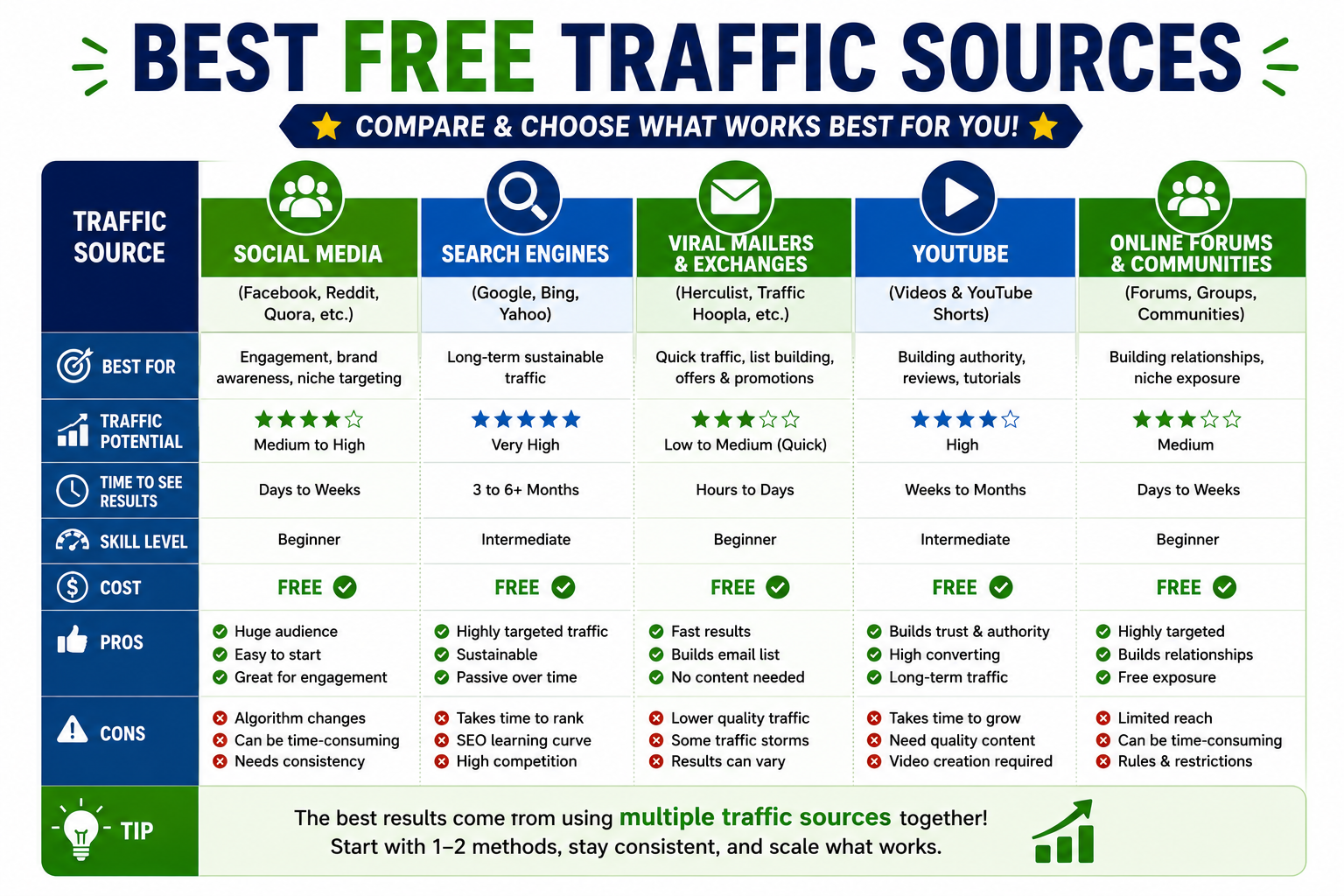
If you’re looking for more ideas, don’t miss my guide 10 Free Ways to Drive Traffic to Your Website.
Google Search
Google remains my favorite long-term traffic source.
Every article you publish is another opportunity to be discovered.
Unlike a social media post that disappears in a day or two, a well-written article can continue attracting visitors for years.
Pinterest is much more like a search engine than a social media platform.
People search for ideas and solutions.
One helpful article can become several different Pinterest pins that continue sending visitors month after month.
YouTube
You don’t have to appear on camera.
Many successful channels use:
- Screen recordings
- Slideshows
- Tutorials
- Voice-over videos
One blog article can easily become a YouTube video.
If your niche is business, affiliate marketing, freelancing, or online income, LinkedIn is an excellent place to share educational content.
Teach first.
Sell second.
Helpful posts almost always outperform promotional ones.
Email Marketing
Every time you publish a new article, send it to your subscribers.
Your email list is one of the few traffic sources you completely control.
Repurpose Everything
One article can become:
- A YouTube video
- Three Pinterest pins
- A LinkedIn article
- Several LinkedIn posts
- Facebook posts
- Email newsletters
- Short-form videos
Repurposing saves time and helps you reach people who prefer different platforms.
A Simple Weekly Content Plan
If you’re wondering how often you should publish, here’s a simple schedule.
Monday: Research a keyword
Tuesday: Write an article
Wednesday: Edit and publish
Thursday: Create Pinterest pins
Friday: Share on LinkedIn and social media
Saturday: Update an older article
Sunday: Plan next week’s content
This schedule is simple enough for most beginners to follow consistently.
Common Affiliate Marketing Mistakes
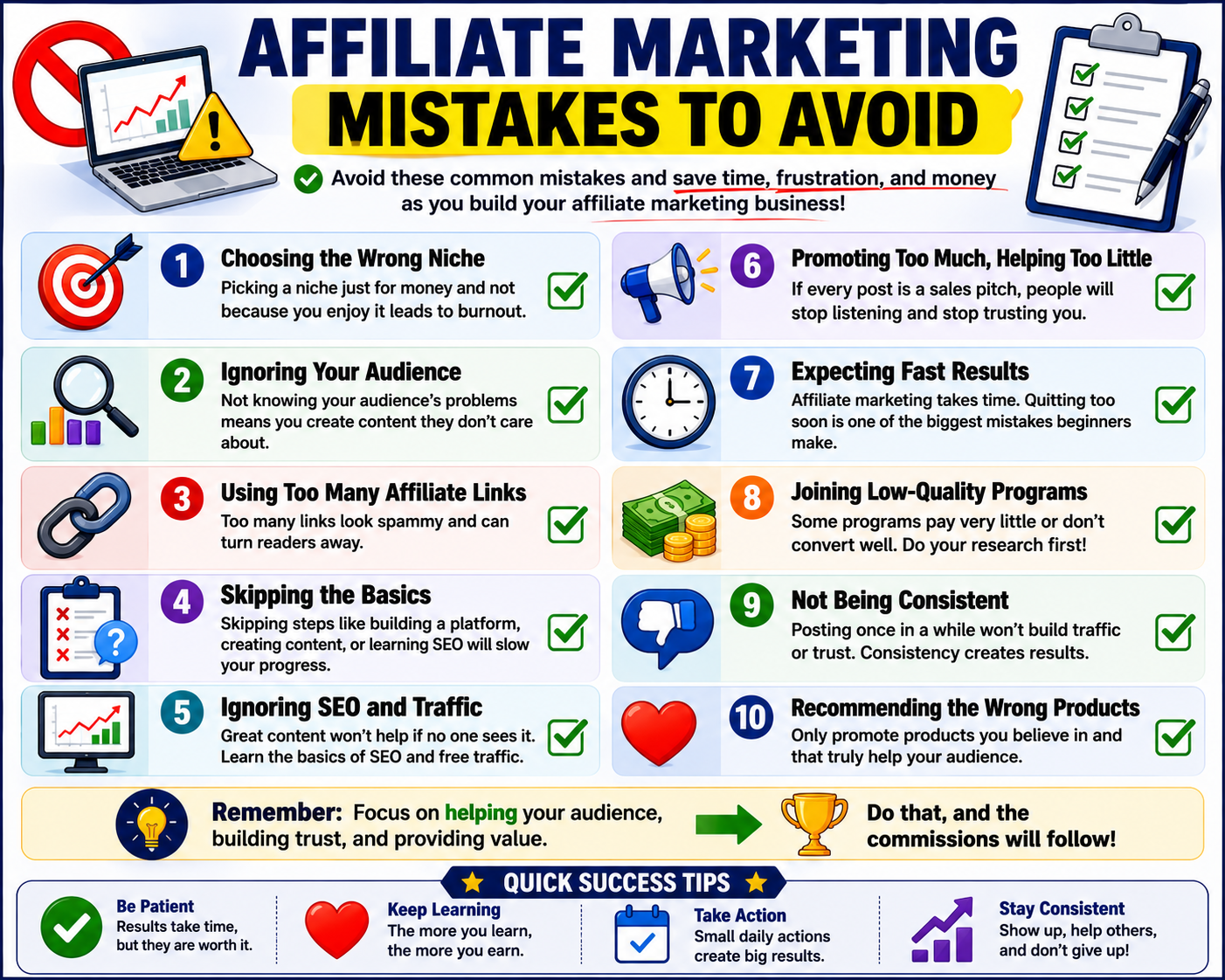
Avoid these mistakes and you’ll save yourself months of frustration.
- Waiting until everything is perfect.
- Promoting too many products.
- Ignoring your readers’ needs.
- Giving up too early.
Consistency almost always beats perfection.
What Happens After Your First Commission?
Your first commission probably won’t make you rich.
But it proves something important.
The system works.
Now ask yourself:
- Which article brought that visitor?
- Which product did they buy?
- What problem were they trying to solve?
Once you know the answer, create more content like that.
Success leaves clues.
Pay attention to them.
Affiliate Marketing vs. Dropshipping
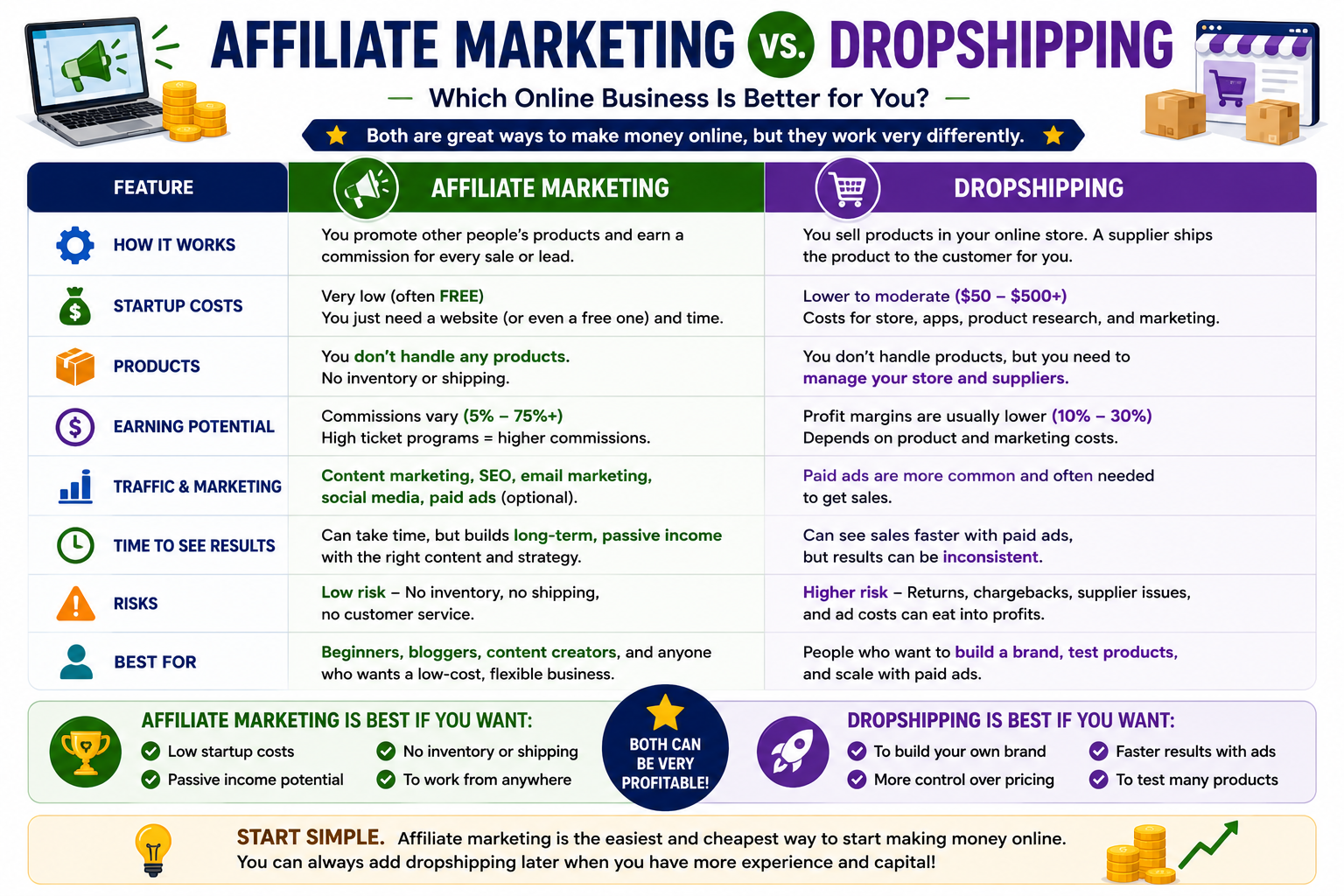
Both business models can work.
But for beginners, affiliate marketing is usually the simpler place to start.
You don’t have to:
- Buy inventory
- Handle shipping
- Process returns
- Provide customer support
Instead, you focus on helping people and recommending products you trust.
Dropshipping often requires more money, more management, and a greater willingness to deal with customer service.
For most beginners, affiliate marketing offers a lower-risk way to learn online business before expanding into other models.
Your 30-Day Beginner Action Plan
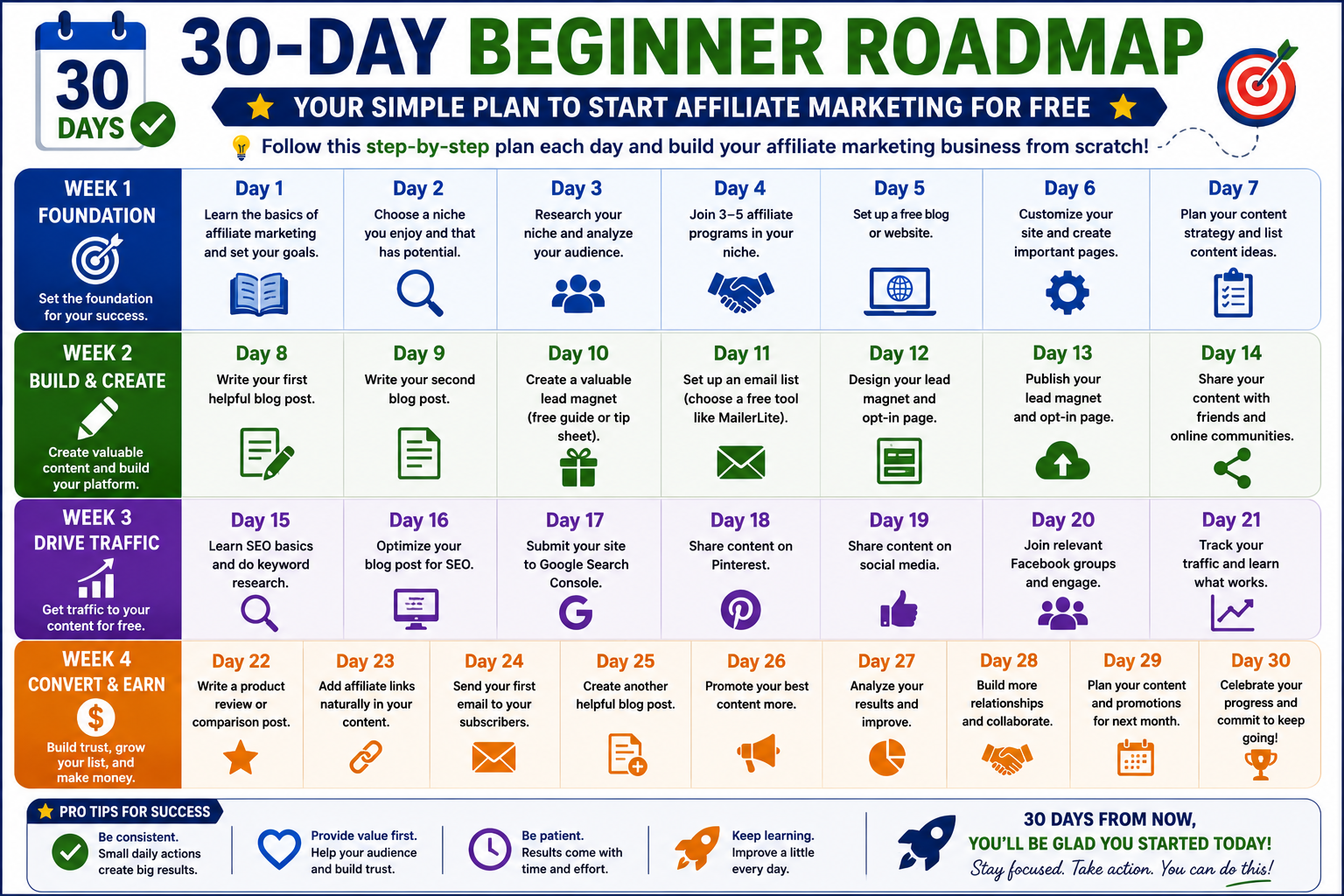
Follow this simple roadmap.
Week 1
- Choose your niche.
- Join affiliate programs.
- Create your website.
- Brainstorm 30 article ideas.
Week 2
- Publish your first two articles.
- Write one product review.
- Create one comparison article.
Week 3
- Learn basic SEO.
- Share your articles.
- Start building your email list.
- Create Pinterest pins.
Week 4
- Update older articles.
- Improve your headlines.
- Add images.
- Publish another helpful article.
- Review your progress.
At the end of 30 days, you’ll have something many beginners never build:
Momentum.
Frequently Asked Questions
How long does it take to make money with affiliate marketing?
Everyone’s journey is different. Some people earn their first commission within weeks, while others take several months. Focus on consistently helping people rather than chasing quick results.
Can I start affiliate marketing with no money?
Yes. Many affiliate programs are free to join, and you can use free blogging platforms, social media, and free tools while you learn.
Do I need a website?
No—but having your own website should be one of your long-term goals because it gives you more control over your content and traffic.
Which affiliate programs are best for beginners?
Look for programs that have a good reputation, products you believe in, and commissions that match your goals. Start with a few quality programs instead of joining dozens.
Is affiliate marketing saturated?
No. Millions of people search Google every day for solutions to problems. New products are launched constantly, and every niche still has room for creators who publish genuinely helpful content.
How many affiliate links should I use?
There isn’t a magic number. Add affiliate links only where they genuinely help the reader. Too many links can make an article feel overly promotional.
Can I do affiliate marketing part-time?
Absolutely. Many successful affiliate marketers started by working on their business for an hour or two each evening while keeping a full-time job.
Final Thoughts
Affiliate marketing isn’t about finding secret shortcuts.
Likewise, it isn’t about tricking people into clicking links.
And it certainly isn’t about getting rich overnight.
Instead, it’s about helping people solve problems.
If you follow the steps in this guide, you’ll know exactly how to start affiliate marketing for free and build a solid foundation for your online business.
Most importantly, if you focus on creating useful content, learning a little more each week, and consistently showing up, you’ll build something that can continue growing for years.
Don’t worry about being perfect.
Just be helpful.
Start where you are.
Use the free tools available to you.
Publish your first article.
Help your first reader.
Then do it again tomorrow.
Small actions repeated consistently often lead to big results.
Quick Start Checklist
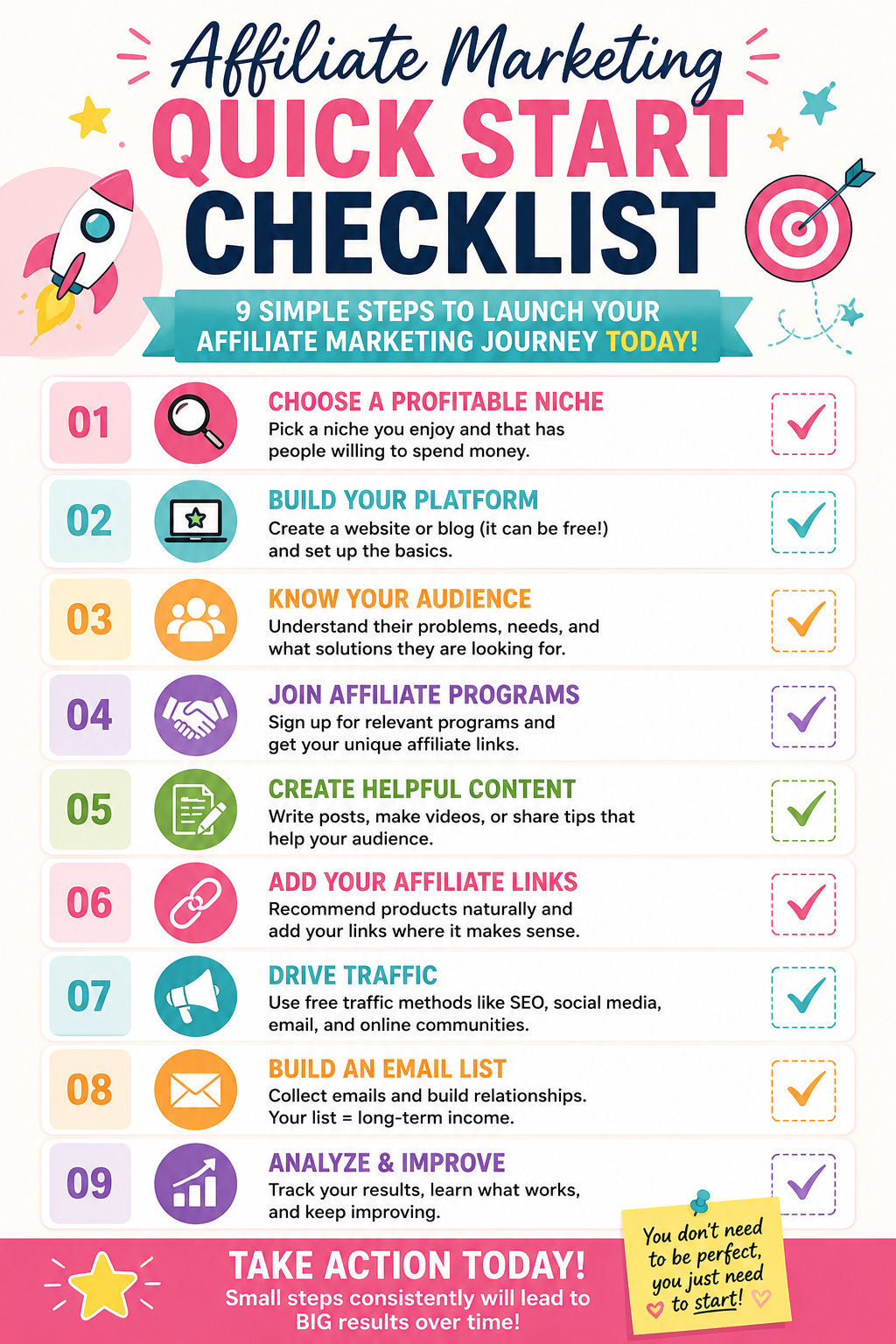
Before you leave, make sure you’ve completed these first steps:
- ✅ Choose one niche.
- ✅ Join two or three trusted affiliate programs.
- ✅ Create your website or a free publishing platform.
- ✅ Write your first helpful article.
- ✅ Learn basic SEO.
- ✅ Share your content.
- ✅ Start building your email list.
- ✅ Publish consistently.
- ✅ Keep learning.
- ✅ Help people first.
If you follow this checklist and stay patient, you’ll give yourself a real opportunity to build a successful affiliate marketing business—without spending a fortune to get started.
The best time to start was yesterday.
The second-best time is today.