If you’ve recently launched a website, you’ve probably had the same experience I did.
You spend hours choosing a domain name, creating pages, writing content, and making everything look perfect.
Then you publish your website and wait for visitors to show up.
One day passes.
Then another.
Then another.
Still no traffic.
I remember checking my website statistics several times a day when I started. I was excited to see visitors coming in.
Instead, I saw mostly zeros.
At first, I thought I needed a better website.
Then I thought I needed more articles.
Eventually, I realized the problem wasn’t my website.
The problem was that nobody knew it existed.
The truth is that getting traffic to a new website takes work, but it doesn’t have to be complicated. If you follow a simple plan and stay consistent, you can start attracting visitors even if your website is brand new.
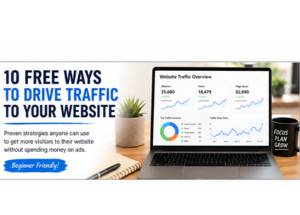
If you’re looking for specific traffic strategies, check out my guide on 10 Free Ways to Drive Traffic to Your Website, where I cover SEO, Pinterest, Facebook Groups, Quora, email marketing, and other proven methods beginners can use for free.
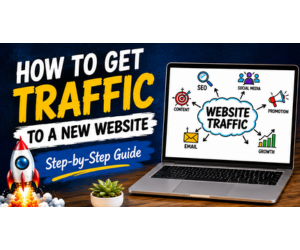
In this guide, I’ll show you exactly how to get traffic to a new website, the best free traffic sources for beginners, and a simple 30-day plan you can start using today.
Why Most New Websites Get No Traffic
The biggest mistake beginners make is thinking that publishing content automatically brings visitors.
Unfortunately, that’s not how the internet works.
Millions of websites are competing for attention. Even if your content is amazing, people still need a way to find it.
Think of your website like a new store in the middle of a huge city.
If nobody knows the store exists, nobody will visit.
That’s why promotion is just as important as content creation.
A good rule to remember is this:
Spend 50% of your time creating content and 50% of your time promoting it.
Step 1: Create Content People Are Already Searching For
Before you start promoting your website, make sure you’re creating content people actually want.
Many beginners write articles based on what they want to talk about.
A better strategy is writing articles based on what people are searching for.
Good Examples
Instead of:
- My Thoughts About Online Business
Write:
- How to Get Traffic to a New Website
- Free Website Traffic for Beginners
- How to Build an Email List From Scratch
- Best Traffic Sources for New Bloggers
- How to Promote a New Website for Free
These topics solve real problems.
That’s exactly what Google wants.
Easy Keyword Research
Start typing a phrase into Google.
Google will suggest additional searches.
These suggestions come from real people searching.
Write them down.
Those are potential article ideas.
Step 2: Learn Basic SEO
SEO stands for Search Engine Optimization.
Don’t let the name scare you.
Basic SEO is actually pretty simple.
Put Your Keyword in Key Places
Include your main keyword:
- In the title
- In the first paragraph
- In at least one heading
- Naturally throughout the article
Don’t force it.
Write naturally.
Use Clear Headings
Headings make your article easier to read.
Visitors can quickly find the information they need.
Google likes organized content because it improves the user experience.
Answer Questions Thoroughly
The more helpful your content is, the better your chances of ranking.
Don’t just tell readers what to do.
Show them exactly how to do it.
Step 3: Create Pinterest Pins for Every Article
Pinterest is one of my favorite beginner traffic sources.
Why?
Because your pins can continue sending traffic long after you create them.
Exact Steps
- Create a Pinterest Business Account.
- Create a board related to your niche.
- Write an article on your website.
- Open Canva.
- Create three vertical Pinterest pins.
- Add a headline that grabs attention.
- Link each pin to your article.
- Publish the pins.
Example
If your article is:
“How to Get Traffic to a New Website”
Your pin title might be:
“7 Free Ways to Get Website Traffic Fast”
Simple.
Helpful.
Clickable.
Pinterest is just one of several traffic methods that work well for new websites. You can see my complete list of free ways to drive traffic to your website if you’d like additional traffic ideas.
Step 4: Repurpose Every Piece of Content
One of the smartest things you can do is get multiple uses from every article.
Many beginners create content once and move on.
Instead, turn one article into many pieces of content.
Example
One blog post can become:
- A LinkedIn article
- Several LinkedIn posts
- Multiple Pinterest pins
- Social media updates
- Email newsletter content
This allows you to reach more people without constantly creating new content.
Step 5: Build an Email List Immediately
If I could start over, I would focus on building my email list from day one.
Traffic comes and goes.
An email list stays with you.
When someone joins your list, you can continue helping them even after they leave your website.
I use GetResponse to build my email list… and I put together a free Affiliate Marketing for Beginners guide that shows the exact system I use to get started. If you want to see how it works, you can check it out here
Offer Something Helpful
Examples include:
- Beginner Traffic Guide
- Website Promotion Checklist
- SEO Starter Guide
- Free Resource List
People love getting something useful.
Ask Only for an Email Address
Many marketers ask for:
- First name
- Last name
- Phone number
- Email address
This creates friction.
For beginners, asking for only an email address often increases conversions.
Step 6: Use LinkedIn to Reach More People
LinkedIn can be a great source of free traffic.
Most people use LinkedIn incorrectly.
They post links and hope for clicks.
A better approach is providing value first.
Exact Steps
- Write a short post sharing a lesson you learned.
- Tell a personal story.
- Give one actionable tip.
- Invite people to read your full article.
People connect with stories more than sales pitches.
Step 7: Use Viral Mailers the Right Way
Many people make the mistake of trying to sell immediately.
That usually doesn’t work.
Instead, focus on generating curiosity.
Example
Instead of:
“Buy this affiliate product.”
Try:
“I discovered a simple traffic strategy that helped me start getting visitors. Here’s what I learned.”
Curiosity encourages clicks.
Clicks create opportunities.
Always Build Your List
Whenever possible, send visitors to a lead capture page first.
Building your email list gives you multiple chances to connect with people.
Step 8: Use Traffic Exchanges as a Testing Tool
Traffic exchanges can be useful when used correctly.
The key is setting realistic expectations.
What Traffic Exchanges Are Good For
- Testing landing pages
- Building an email list
- Testing headlines
- Generating exposure
What They Are Not Good For
- Instant sales
- Overnight success
- Passive income
Use them as a learning tool and lead-generation source.
I always use Traffic Hoopla to find out which traffic exchanges and viral mailers are performing the best. You can get a free Traffic Hoopla account by clicking here.
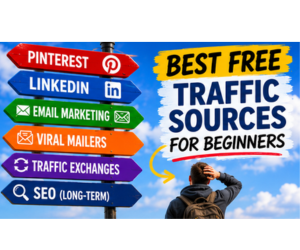
The Best Free Traffic Sources for Beginners
Not all traffic sources are equal.
Here’s how I would rank them for beginners.
| Traffic Source | Difficulty | Speed |
|---|---|---|
| Easy | Fast | |
| Easy | Fast | |
| Email Marketing | Easy | Medium |
| Traffic Exchanges | Easy | Fast |
| Viral Mailers | Easy | Fast |
| SEO | Medium | Slow |
Notice that SEO is listed as slow.
That’s because SEO usually takes time.
But it can become one of your best long-term traffic sources.
How Long Does It Take to Get Traffic?
This is one of the most common questions beginners ask.
The honest answer is:
It depends.
Often days to weeks.
Sometimes within hours.
Viral Mailers
Usually immediately.
Traffic Exchanges
Usually immediately.
SEO
Often several months.
This is why using multiple traffic sources can be helpful.
You can get short-term traffic while waiting for SEO to grow.
A Simple 30-Day Traffic Plan
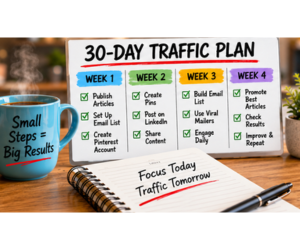
Here’s exactly what I would do if I started a new website today.
Week 1
- Publish two helpful articles.
- Create an email opt-in page.
- Create a Pinterest account.
Week 2
- Publish two more articles.
- Create three pins for each article.
- Start posting on LinkedIn.
Week 3
- Continue publishing content.
- Build your email list.
- Test different headlines.
Week 4
- Promote your best articles daily.
- Review your traffic statistics.
- Double down on what’s working.
By the end of the month, you’ll have content, promotion channels, and a growing audience.
Common Mistakes That Keep New Websites Invisible
Publishing and Waiting
Traffic rarely appears automatically.
Promotion matters.
Chasing Too Many Traffic Sources
Focus on a few methods and get good at them.
Ignoring Email Marketing
Your email list is one of the few assets you truly own.
Quitting Too Soon
Many successful websites receive very little traffic during their first few months.
Consistency is often the difference between success and failure.
My Daily Traffic Routine
If I were starting from scratch today, this is exactly what I would do.
Morning
- Research one topic.
- Write 500 to 1,000 words.
Afternoon
- Create Pinterest pins.
- Schedule social media content.
Evening
- Check statistics.
- Grow my email list.
- Promote content.
This simple routine takes about one to two hours per day.
Over time, those small daily actions add up.

What Should You Do Next?
Now that you understand how to get traffic to a new website, your next step is learning which traffic sources deserve most of your attention. That’s why I recommend reading my guide on 10 Free Ways to Drive Traffic to Your Website, where I break down the exact methods beginners can start using today.
Final Thoughts
Learning how to get traffic to a new website doesn’t require special skills, expensive software, or a huge advertising budget.
What it requires is consistency.
Create content people want.
Learn basic SEO.
Use Pinterest.
Share on LinkedIn.
Build an email list.
Promote your content every day.
Most people quit before they see results.
Don’t be one of them.
Stay consistent, keep learning, and keep helping your audience.
Six months from now, you’ll be glad you started today.